+995 595 251 800 info@cambridge.ge
+995 595 251 800 info@cambridge.ge
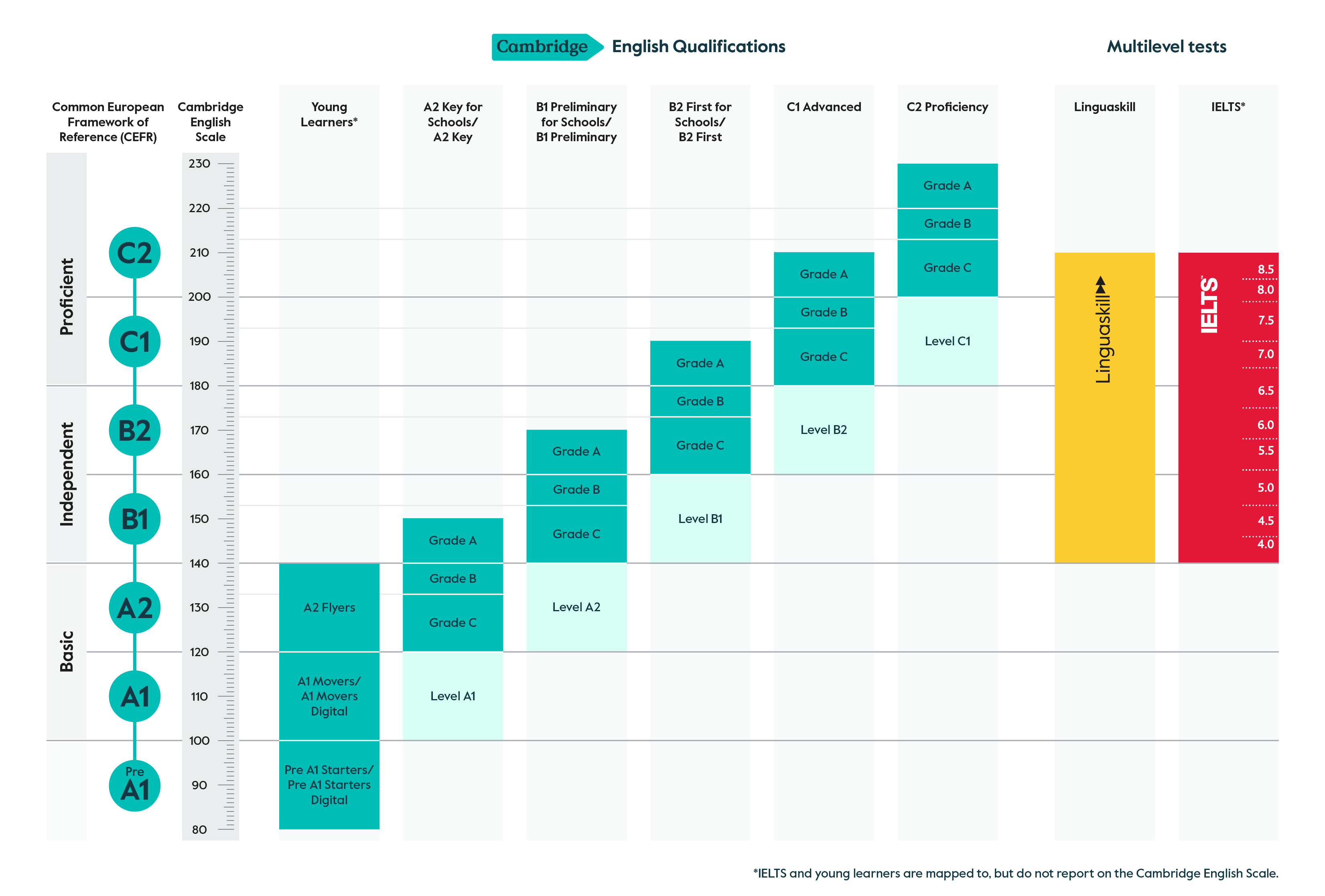
Cambridge English exams are internationally recognized certificates that certify language proficiency levels according to the Common European Framework of Reference for Languages (CEFR), from A1 to C2. The certificates are valid for life and are recognized by leading universities and employers around the world.
Cambridge English exams are designed by Cambridge Assessment English (UK) at the University of Cambridge for people who are learning English as a foreign language and whose first language is not English.
Some facts
Every year, more than 2 million people in 130 countries around the world take Cambridge exams and receive an internationally recognised qualification. A Cambridge exam certificate is valid for life and does not require re-siting.
Exam Format
Cambridge ESOL exams consist of five tests (KET, PET, FCE, CAE, CPE), each of which is designed for the appropriate level of knowledge of the examinee.
KET (Key English Test) tests the basic level of English proficiency (Pre-Intermediate). The KET exam consists of three parts: reading and writing, listening, speaking.
PET (Preliminary English Test) implies proficiency in English at the Intermediate level, that is, above the basic level. Testing stages: reading and writing, listening, speaking.
FCE (First Certificate in English) – the most popular international exam from this group – is designed for candidates with B2 knowledge. The exam consists of five parts: reading, writing, use of English, listening and speaking.
CAE (Certificate in Advanced English) – is designed for candidates with a high level of knowledge. Testing stages: reading, writing, use of English, listening and speaking.
CPE (Certificate of Proficiency in English) – is a higher-level exam, meaning that you have almost native-like language skills.
 1913
1913The first exam sessions were held.
 5.5 million
People take exams around the world every year.
 In 130 countries
Exam sessions are held annually.
Cambridge exams are designed to assess your level of English language proficiency. A Cambridge Assessment English certificate is an official document that confirms your level of English language proficiency. Passing a Cambridge English exam (for example, KET, PET, IELTS) is mandatory for studying at foreign schools and universities, as well as for employment in the UK, Australia, the USA and other English-speaking countries. You will also need a Cambridge English certificate to obtain permanent residence documents in an English-speaking country.
More than 25,000 organizations, including schools, universities, government agencies, private and public companies, recognize Cambridge certificates and the objectivity of the language proficiency they demonstrate. With a Cambridge certificate, people can enter university, find a job and feel comfortable anywhere where English is the main means of communication.
 Geo
Geo  Eng
Eng 